




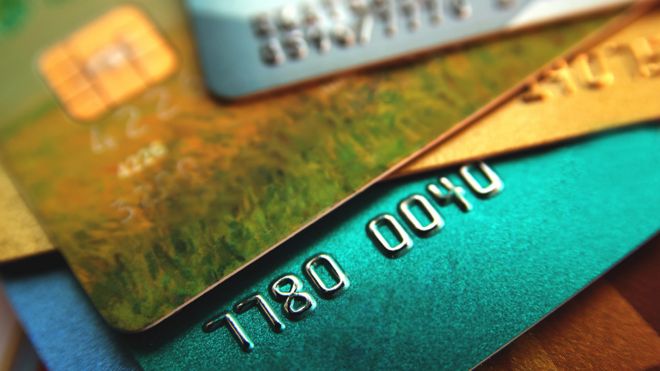
The clue is in the name: credit. It means belief, trust.
If
you're a shopkeeper, who do you trust to repay a debt? For most of
history, only someone you knew personally, which was fine since most of
the people you encountered would be from the same small community.
But as cities boomed, things became more awkward.
Large
department stores couldn't rely on employees to recognise every
customer by sight. So retailers issued tokens to trusted customers -
special coins, key-rings, and in 1928, even objects resembling dog tags
called "charga-plates".
Show one of those, and a shop assistant who didn't know you would
happily let you walk out of the store with an armful of goods you'd not
yet paid for. Some of those credit tokens became status symbols in their
own right.
In 1947 came the first token that allowed someone to
get credit not just from a single store, but from a range of stores: the
Charg-It. Admittedly, this worked only within a two-block area of
Brooklyn.
But then, in 1949, came the Diners Club card, aimed at the travelling salesman.
It would let him (and it was usually him) buy food
and fuel, rent hotel rooms, and entertain clients at a network of
outlets around the United States.
And it took off: 35,000 people
subscribed in the first year, as the company rushed to sign up hotels,
airlines, petrol stations and car hire firms.
In the 1950s came the American Express charge card, and credit cards set up by banks.
Overcoming inertia
Bank of America's imaginatively named BankAmericard would eventually become Visa. Its rival, Master Charge, became MasterCard.
But the early credit cards had two big problems to solve.
One
was chicken-and-egg: retailers wouldn't accept the cards without
significant consumer demand. Conversely many customers couldn't be
bothered to sign up unless plenty of retailers would take them.
To overcome the inertia, in 1958 Bank of America
experimented by simply mailing a plastic credit card to every single
customer in Fresno, California - 60,000 of them.
Each card had a credit limit of $500 (£380), no questions asked - closer to $5,000 (£3,800) in today's terms.
This
audacious move became known as the Fresno Drop. The bank took losses,
of course, from delinquent loans, and outright fraud by criminals who
simply stole the cards out of people's mailboxes.
But the Fresno
Drop was quickly emulated. The banks swallowed the losses, and by the
end of 1960, Bank of America alone had a million credit cards in
circulation.
50 Things That Made the Modern Economy highlights the inventions, ideas and innovations which have helped create the economic world in which we live.
It is broadcast on the BBC World Service. You can find more information about the programme's sources and listen online or subscribe to the programme podcast.
Listeners were invited to vote for the 51st Thing That Made the Modern Economy from a shortlist of six inventions: glass, GPS, the pencil, irrigation, spreadsheets and credit cards.
The other problem was inconvenience. Pull out a
credit card and the shop assistant would have to phone up your bank and
chat to a teller to get the transaction approved.
But new technologies helped to make the process of spending ever more painless.
Chief
among them was the magnetic strip - originally developed in the early
1960s by Forrest and Dorothea Parry for use on CIA identity cards.
Forrest
was an IBM engineer who came home one evening with a plastic card and
information encoded on a strip of magnetic tape, trying to figure out
how to attach one to the other. His wife Dorothea, who was ironing at
the time, handed him the iron and told him to try it.
The combination of heat and pressure worked perfectly, and the magnetic strip was born.
Thanks
to the strip, you could now swipe a Visa card in a shop. The shop would
send a message to its bank, which would send a message to the Visa
network computers, and the Visa computers would send a message to your
bank.
Cultural shift
If
your bank was happy to trust you to repay, nobody else had to worry. The
digital thumbs-up passed all the way back through these computers to
the shop, which would issue a receipt and let you walk out of the door
with your stuff. The whole process took just a few seconds.
So
the credit card spread everywhere - and anyone could tap into a network
of trust that was once the preserve of upstanding members of a
tight-knit community.
It was a huge cultural shift. There was no
need to genuflect to a bank manager as you begged for a loan and
explained what you wanted it for.
You could spend on anything,
and roll the debt over again and again until you were ready to pay at
your own convenience - as long as you didn't mind paying interest rates
that could easily be 20% or 30%.
More from Tim Harford:
But having such effortless, impersonal credit on tap might be doing strange things to our psychology.
A few years ago, two researchers from MIT, Drazen Prelec and Duncan Simester, ran an experiment to test whether credit cards made us more relaxed about spending money.
They
allowed two groups of subjects to bid in an auction to buy tickets for
popular sports fixtures. These tickets were valuable, but exactly how
valuable wasn't clear. One group was told they had to pay with cash -
but not to worry, there was an ATM around the corner if they won.
The
other group was told that only payment by credit card would be
accepted. There was a striking difference in the results: the
credit-card group bid substantially more for the tickets, more than
twice as much in the case of a particularly popular match.
The death of cash?
That matters, because in some places cash is fast becoming obsolete.
In Sweden only 20% of payments at shops are made with cash - and just 1% of total spending by value is via cash.
Back in 1970, a BankAmericard advertising slogan had been, "Think of it as money."
Now,
for many transactions, physical money won't do: an airline or a car
hire firm or a hotel wants your credit card, not your cash. In Sweden
the same is true even of coffee shops, bars and sometimes market stalls.
Credit
cards can - used wisely - help us manage our money. The risk is that
they make it simply too easy to spend money - money we don't necessarily
have.
Rotating credit - that distinctive feature of a credit
card - is now around $860bn (£656bn) in the United States, more than
$2,500 (£1,900) for every American adult.
In real terms, it's expanded four-hundred fold in 50 years.
And a a recent study by the International Monetary Fund
concluded that household debt - the kind of debt credit cards make it
easy to accumulate - was the economic equivalent of a sugar rush.
It
was good for growth in the short term, but bad over a three to five
year horizon - as well as making banking crises more likely.
If you ask people about all this, they worry.
Faced
with the statement "credit card companies make too much credit
available to most people", nine out of 10 Americans with credit cards
agree. Most of them strongly agree. Yet when they reflect on their own
cards, they're satisfied.
We don't trust each other to wield these powerful financial tools responsibly, it seems.
But we do trust ourselves. I wonder if we should.
Tim Harford writes the Financial Times's Undercover Economist column. 50 Things That Made the Modern Economy is broadcast on the BBC World Service. You can find more information about the programme's sources and listen online or subscribe to the programme podcast. Listeners voted for the credit card to be the 51st Thing That Made the Modern Economy from a shortlist of six inventions.


.jpg)


No comments:
Post a Comment
Please do not enter any spam link in the comment box.